
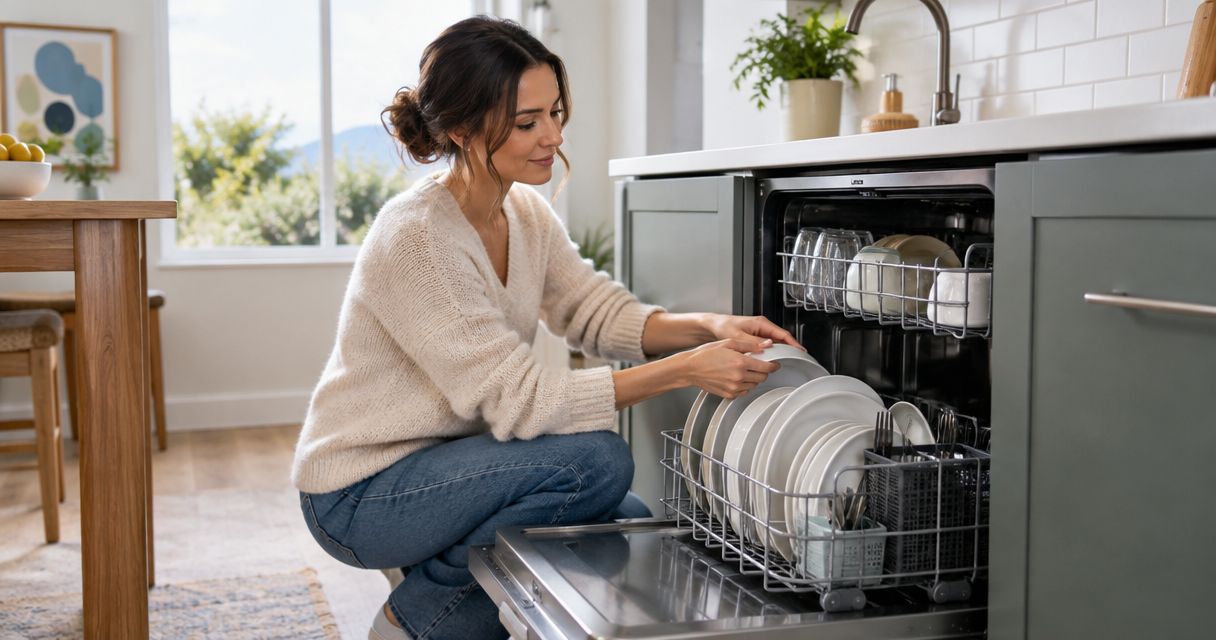
Best overall in 2026: a dishwasher with a built-in water softener, if its manual supports your measured water hardness. Best for a home with softened water: a standard dishwasher set up for that treated supply. Best for a home without water treatment or plumbing changes: a dishwasher with adjustable rinse-aid dispensing and a filter you can remove for cleaning. Measure the water before you choose a machine; white residue alone does not prove the dishwasher needs replacing.
- The best dishwashers for hard water areas have a built-in softener when the water supply is untreated.
- If your home already softens its water, confirm the dishwasher's settings match the treated supply before buying another treatment feature.
- White film can also come from detergent, rinse aid or a dirty filter; diagnose it before replacing a working dishwasher.
- Affordable Appliance Care repairs dishwashers in Los Angeles and Ventura County when cleaning and setting changes do not solve the problem.
Why hard water changes the buying decision
Hard water contains dissolved minerals that can leave deposits on glasses and inside a dishwasher. A new machine does not remove those minerals unless its water-treatment setup addresses the water entering it. Before comparing models, check the Affordable Appliance Care repair option if your current dishwasher has stopped cleaning properly; a fault and a water-quality problem call for different fixes.
The US Geological Survey classifies water containing 121–180 mg/L of calcium carbonate as hard and water above 180 mg/L as very hard. Those are classifications of the water supply, not dishwasher performance ratings. Test the water feeding the machine, including after any existing home softener, rather than relying on a regional average. For a Los Angeles County homeowner or property manager in 2026, the useful question is not which brand claims to handle hard water. It is whether the dishwasher and the home's water treatment work together.
What makes the best dishwasher for hard water areas?
Use these criteria before reading a product listing or accepting a replacement recommendation:
- Water treatment: Does the specific model have a built-in softener, or will it receive water that is already softened? Do not assume every model from a brand includes one.
- Hardness setup: Does the manual explain how to set the machine for the hardness you measured? A feature you cannot configure correctly is a poor reason to buy.
- Rinse-aid control: Can you adjust dispensing if dishes show spots or streaks? Check the manual for the model, not a description of the product family.
- Filter access: Can you remove and clean the filter as directed? Trapped food and mineral residue complicate troubleshooting when dishes come out dirty.
- Fit with existing plumbing: Confirm whether a treatment feature duplicates equipment already serving the dishwasher. The inlet water matters more than a feature list.
- Repairability of the current machine: If the existing dishwasher washes and drains but leaves film, identify the film before treating replacement as the first step.
These criteria rank configurations, not unverified brand models. No particular dishwasher model, specification or price is established here. In 2026, check the current manual for any machine on your shortlist before making a purchase decision.
The options at a glance
| Dishwasher configuration | Best for | Standout feature | Key limitation |
|---|---|---|---|
| Built-in water softener | Untreated hard water | Treats water within the dishwasher when configured as directed | Adds a setup and maintenance task; availability varies by model |
| Standard dishwasher supplied with softened water | Homes with an existing working softener | Uses the home's treated supply | Cannot compensate for a home softener that is bypassed or not working |
| Adjustable rinse aid and removable filter | Homes avoiding a water-treatment change | Gives you accessible cleaning and spotting controls | Does not soften incoming water |
Best overall does not mean best for every kitchen. A built-in softener addresses untreated hard water directly. If the dishwasher already receives softened water, confirm that setup first; buying another softening feature does not diagnose why dishes are spotted.
1. Built-in water softener: best for untreated hard water
A dishwasher with a built-in softener is the strongest match when testing confirms that hard water reaches the appliance and the home does not already treat it. Check the exact model's manual for its hardness settings and maintenance instructions. Brand-level descriptions are not enough: the feature must be present on the machine you intend to buy.
Built-in-softener pros:
- Addresses incoming water hardness inside the dishwasher.
- Gives you a direct setting to match to a measured water-hardness result when the model provides one.
- Keeps the dishwasher decision focused on the appliance rather than assuming the whole home needs treatment.
Built-in-softener cons:
- Requires setup and ongoing maintenance according to the model's manual.
- Does not fix a blocked filter, drainage fault or other cleaning problem.
- Is unnecessary as a first response if the dishwasher already receives adequately softened water.
Best for: A household or managed property with confirmed untreated hard water and no working softener feeding the dishwasher. If you already own a machine with this feature, check its settings and maintenance requirements before replacing it. Verdict: Buy this configuration when untreated hard water is confirmed and you are prepared to maintain the system the manual specifies.
2. Standard dishwasher with softened supply: best for treated homes
If a working home softener already treats the dishwasher's supply, the treatment decision has been made upstream. A standard dishwasher can be a sensible choice; compare its cleaning, fit and maintenance requirements without assuming that a second softener is essential. First confirm that the dishwasher actually receives treated water rather than an untreated or bypassed line.
Softened-supply pros:
- Uses water treatment the property already has.
- Avoids making an appliance feature responsible for a problem originating elsewhere in the plumbing.
- Lets you investigate spotting by checking the treatment system and dishwasher separately.
Softened-supply cons:
- Depends on the existing softener working and serving the dishwasher's supply.
- Offers no appliance-level softening if the incoming water is untreated.
- Still needs routine dishwasher cleaning and correct detergent and rinse-aid use.
Best for: A home or managed property where testing confirms that the dishwasher receives softened water. In 2026, verify the inlet supply before ruling out or paying attention to an appliance-level softener; a kitchen tap result is not a substitute if the lines are supplied differently. Verdict: Buy a suitable standard configuration when treated water reaches the dishwasher and the current machine truly needs replacement.
3. Adjustable rinse aid and removable filter: best for simple upkeep
A dishwasher with adjustable rinse-aid dispensing and a filter you can remove is a practical option when you want easier troubleshooting without changing water treatment. Rinse aid helps water drain from dishes; a clean filter helps prevent trapped debris from interfering with washing. Neither feature removes hardness minerals from the incoming supply.
Rinse-aid-and-filter pros:
- Lets you adjust rinse-aid dispensing when spotting or streaking changes.
- Makes the filter accessible for cleaning according to the manual.
- Provides straightforward checks before you attribute every cloudy load to hard water.
Rinse-aid-and-filter cons:
- Does not treat hard water.
- Cannot resolve a mechanical fault by itself.
- Requires you to distinguish mineral film from food residue and other cleaning problems.
Best for: A household prioritizing accessible upkeep, especially where water testing does not justify selecting a built-in softener. If testing confirms hard water and deposits keep returning, this configuration alone is not the water-treatment answer. Verdict: Hold as a hard-water purchase until you know what water reaches the dishwasher.
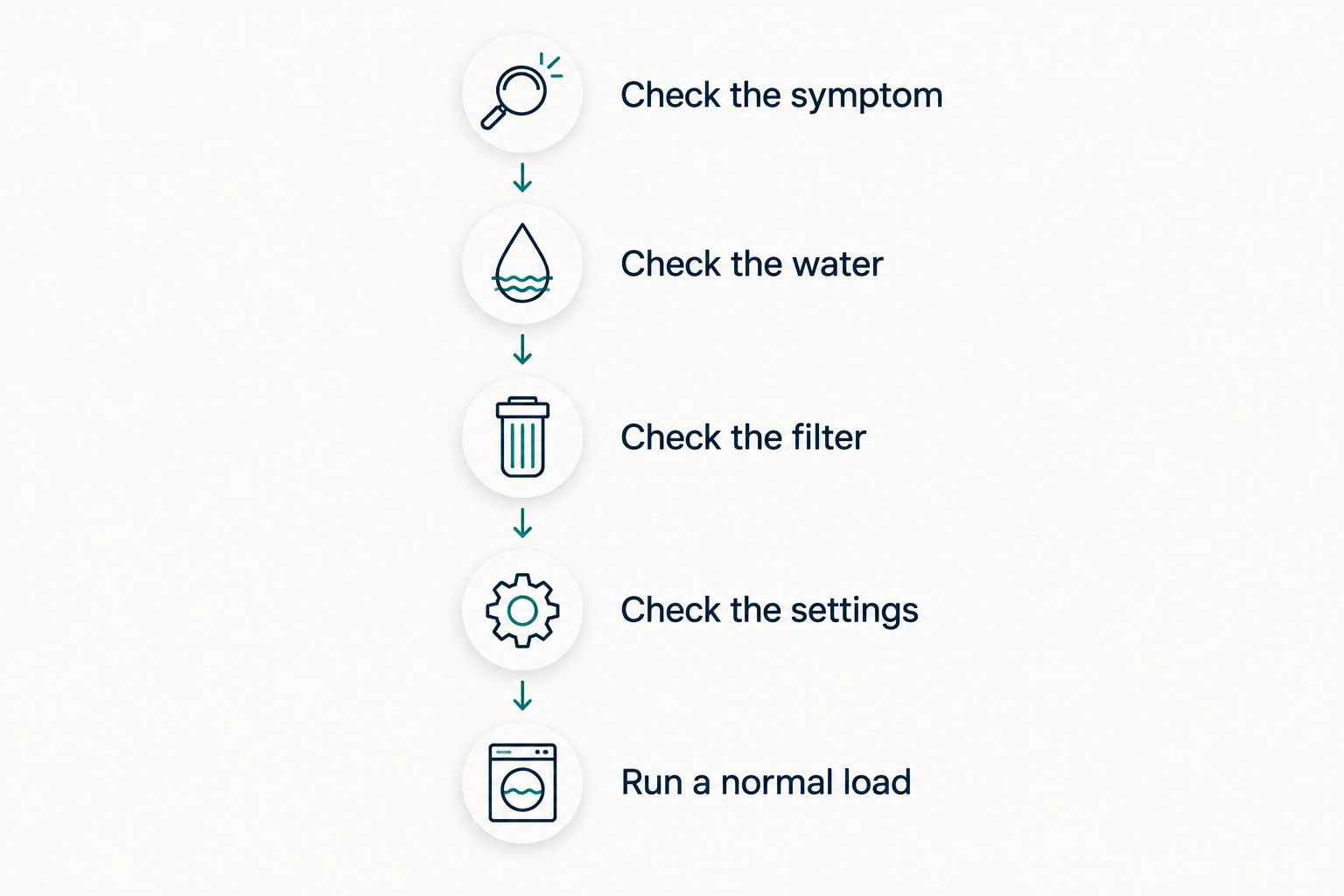
Quick troubleshooting checklist before you replace anything
Start with checks that do not require opening electrical panels or disconnecting plumbing. Work in this order so you do not replace an appliance to solve a setting or supply problem:
- Check the symptom. Is there a white coating on otherwise clean dishes, food still attached, standing water, or a machine that fails to run? Those symptoms point to different checks.
- Check the water. Test the water feeding the dishwasher. If the property has a softener, confirm whether that supply is treated and whether the softener is functioning as intended.
- Check the filter. Follow the dishwasher manual to remove and clean an accessible filter. Do not force parts that the manual does not identify as user-removable.
- Check the settings. Compare the measured hardness with the manual's hardness setting, if the model has one. Review rinse-aid dispensing and use detergent as the manual directs.
- Run a normal load. See whether the original symptom remains after the safe checks. If it does, record whether the problem affects every dish or only certain items.
A white coating deserves one more distinction: a deposit on the dishwasher interior and a cloudy glass are not automatically the same problem. Do not use abrasive cleaning to test the glass. Follow the glassware and appliance care instructions, then use your water-test result to decide whether mineral deposits are a credible cause.
Stop and call a professional if the dishwasher leaks, trips a breaker, will not drain, fails to heat as expected, or continues to leave dishes dirty after the manual-approved checks. Keep electrical components and water connections untouched. Affordable Appliance Care provides dishwasher repair for residential and commercial customers across Los Angeles and Ventura County; describe the symptom, what changed, and which checks you completed.
Get help with dishwasher trouble
Share the symptom and the checks you have already made.
Repair or replace: use the fault, not the film
For 2026, separate a water-quality decision from an appliance-failure decision. If the machine completes cycles and the main complaint is spotting, test the water and review the settings before shopping. A replacement connected to the same untreated supply can face the same mineral exposure. If the machine leaks or stops washing, draining or heating properly, diagnose that fault before comparing replacement configurations.
Use this decision sequence with a technician or property manager:
- Identify the actual fault. State whether the concern is residue, cleaning, drainage, a leak or failure to start. Do not treat all of them as hard-water symptoms.
- Establish the cause. Ask what part or condition explains the symptom and whether water quality is separate from the repair.
- Compare the choices. Review the proposed repair against a suitable replacement for the property's water supply. Check current terms and appliance details directly; do not rely on a generic price rule.
- Plan for the next machine. If you replace it, record the inlet hardness and retain the model's setup instructions. The next installer or property manager needs both.
This approach matters for rental properties as well as single households. A report that glasses look spotted is not the same as a report that the dishwasher has stopped draining. Clear symptoms help you decide whether to clean, adjust, test, repair or replace without repeated visits to the wrong problem.
How these configurations were ranked
The ranking puts treatment of confirmed untreated hard water first, compatibility with an existing softened supply second, and accessible upkeep third. That is a decision tree, not a claim that one unlisted model outperforms another. Adjustable rinse aid and filter access are useful, but they cannot substitute for treatment when incoming hardness is the issue.
Once you have the water result, assess model-specific reliability separately from the hard-water feature. The dishwasher brands for reliability guide covers that separate buying question. Affordable Appliance Care's role is to help diagnose and repair a malfunctioning dishwasher, not to present an unsupported brand ranking as a water test.
Which dishwasher should you choose in 2026?
Choose a dishwasher with a built-in softener if hard water reaches the machine untreated and its manual supports your measured hardness. If the supply is already softened, choose a dishwasher suited to the property and confirm the existing treatment works. If you have not tested the water, hold off on a hard-water-specific purchase and start with the troubleshooting checklist.
For a working dishwasher that only leaves spots, replacement is not the default. For a leaking or malfunctioning one, the fault diagnosis comes first. Affordable Appliance Care repairs dishwashers in Los Angeles and Ventura County when the safe checks do not resolve the problem.
FAQ
What are the best dishwashers for hard water areas in 2026?
A dishwasher with a built-in water softener is the best configuration when tested hard water reaches it untreated. If the home already supplies softened water, confirm that treatment works before prioritizing another softener in the appliance.
Does every dishwasher with a built-in softener work the same way?
No. Check the exact model's manual for its hardness settings and maintenance instructions; a brand name alone does not establish which features a model includes.
Will rinse aid soften hard water?
No. Rinse aid helps water drain from dishes but does not remove hardness minerals from the incoming water. Test the water if mineral deposits continue.
Should I replace my dishwasher because glasses look cloudy?
No. Identify the cause before replacing a working dishwasher; check the inlet water, filter, rinse aid and model settings first. A new machine connected to the same untreated supply does not change that supply.
How can I tell whether my water is hard?
Test the water feeding the dishwasher and compare the result with the US Geological Survey hardness categories. Water at 121–180 mg/L as calcium carbonate is classified as hard; water above 180 mg/L is very hard.
Is a dishwasher softener useful if my home already has a softener?
Confirm what water reaches the dishwasher first. An appliance-level softener is not the first feature to prioritize when a working home system already treats that supply.
When should I call for dishwasher repair instead of adjusting settings?
Call a professional for leaks, electrical trips, drainage failure, heating trouble or cleaning problems that persist after manual-approved checks. Do not open electrical panels or disconnect water lines to investigate.
One last thing
Test the water at the dishwasher's supply, not just somewhere else in the house. The 2026 shortlist changes if that line is untreated, already softened or not served by the treatment system you expected. Record the result alongside the machine's model and symptoms; it makes the next repair-or-replace decision more precise.